What's new
LiteRECORDS

Register a free account today to become a member! Once signed in, you'll be able to participate on this site by adding your own topics and posts, as well as connect with other members through your own private inbox!

  • Guest, before your account can be reviewed you must click the activation link sent to your email account. Please ensure you check your junk folders.
    If you do not see the link after 24 hours please open a support ticket.

Stem Extraction Tools Updates

Thr33

Admin
Platinum Legend
Live DJ
Promotor

Stem Extraction Tools v3 BETA​

Screenshot 2026-09-03 at 17.39.38.jpg

LiteLABS v3 has moved on quite a bit since the first BETA release.

The original v3 update introduced much more detailed stem separation, including parent stems such as Vocals, Percussion, Bass, Strings, Keys and Other, alongside experimental breakdowns such as Lead Vocals, Backing Vocals, Kick, Snare, Toms, Hi-Hats, Cymbals, Wind / Brass and Saxophone.

Since then, we’ve reworked both the extraction system and the user interface around one goal:
Give users the stems they actually need, without forcing every extraction into one enormous pack.

New extraction packs​

LiteLABS can now offer different preset packs depending on your account permissions.
The available packs are supplied directly by the LiteLABS processing server, so the list can evolve as our models and separation tools improve.
Current BETA presets include:

Basic
  • Instrumental
  • Vocals
Core
  • Vocals
  • Percussion
  • Bass
  • Strings
  • Keys
  • Other
Experimental
  • Lead Vocals
  • Backing Vocals
  • Kick
  • Snare
  • Toms
  • Hi-Hats
  • Cymbals
  • Bass
  • Strings
  • Keys
  • Other
  • Wind / Brass
  • Saxophone
Not every account will necessarily have access to every pack.

A completely redesigned extraction workflow​

The Stem Extraction Tools interface has been rebuilt into a simpler step-by-step process.
You now:
  1. Upload or drag and drop your audio file.
  2. LiteLABS analyses the track locally.
  3. Choose an available extraction pack.
  4. Choose MP3 or FLAC and confirm the credit cost.
  5. Follow the live extraction progress.
  6. Download the finished stem pack.
Only the current stage is shown, making the tool much less cluttered than the previous interface.

Drag & drop uploads​

You no longer have to use the file picker.
Audio can now be dragged directly onto the upload area.
Supported source formats remain:
  • MP3
  • WAV
  • FLAC
  • M4A

Faster track analysis​

LiteLABS now reads track duration locally in your browser rather than uploading the entire file just to inspect its metadata.
For most tracks this takes only a moment.
This also avoids unnecessarily uploading large files twice.

Larger files and automatic credit scaling​

LiteLABS now handles longer audio much more gracefully.
Instead of simply preventing longer uploads, files are processed in 15-minute chunks. The credit charge shown before extraction reflects how many chunks are required.

So if you upload a longer mix, compilation or extended recording, LiteLABS automatically adjusts the displayed credit cost rather than simply rejecting it because of duration.
Large source files are also uploaded in smaller chunks behind the scenes, which makes bigger uploads more reliable and avoids relying on one huge web request.

Different pack pricing​

Different extraction packs can now have different credit costs.
This means a smaller two-stem extraction does not have to be treated the same as a much more demanding detailed separation.
Pricing and pack access may also vary depending on your LiteRECORDS account.

Smarter queue behaviour​

You no longer need to keep refreshing the page when another extraction is using the worker.
LiteLABS checks availability automatically via AJAX and updates the interface when the queue becomes available.

Better processing feedback​

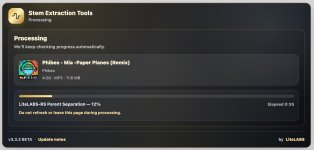
The processing screen now shows:
  • track information
  • current processing stage
  • progress
  • elapsed time
The processing worker can also report more specific stages, such as individual separation passes, rather than leaving users with a generic waiting message.

Improved README files​

README files are now standardised across preset packs and include useful information such as:
  • track
  • selected extraction pack
  • output format
  • included stems

Automatic feedback requests​

After a successful extraction, selected users may receive a LiteBOT conversation asking for feedback.
The review form feeds back into our testing and research process, helping us decide which models, stems and separation techniques are genuinely worth keeping.

PRO benefits​

The widget can also display LiteLABS upgrade benefits directly to eligible members.
Depending on current settings, PRO may offer benefits such as:
  • lower extraction credit costs
  • shorter cooldowns
  • larger upload limits
  • additional extraction packs or formats

Still BETA​

The BETA label is mainly there because the detailed stems and model combinations are still being tuned.
The core extraction system is usable, but we are continuing to test model weights, processing order, instrument detection and the usefulness of some of the deeper stem breakdowns.
The goal remains the same: not simply to produce more stems, but to produce stems that are actually useful.


We are constantly trying to upgrade all of our services and features so please do let us know where we can improve.
 
Sounds great! I need to find some time to mess around with it a bit, been very busy as of late. Thanks for the continual updates and upgrades to the A.I. and the website!
 
Captain's Log
Our goal with Stem Extraction Tools (SET) by LiteLABS has always been simple: produce the best possible, studio-like stems.

That means SET shouldn’t just take a track and immediately start separating it. First, it should analyse the audio in detail, understand what it’s working with, and then choose the extraction process best suited to that particular track. Different music requires different treatment, and SET is built around making that decision before extraction even begins.

Update 3.4.x
Improve SET’s genre detection by combining our existing analysis with enhanced third-party classification. The goal is to make genre recognition more accurate and consistent, giving SET a stronger foundation for deciding how each track should be processed.

Update 3.5.x
Expand SET’s analysis beyond genre by identifying the instruments and key elements present within each track. This deeper understanding will allow SET to choose the most suitable extraction route, apply tailored parameters, and select the specialised software best suited to the material.

Some may have noticed and used the 'Experimental' pack which gave you an insight into what's coming next. It's currently unavailable while we perform the next steps. This is what we're currently working on. During development you may notice the widget become inaccessible, this is to prevent user disruption.
 
Following on from the 3.4.x and 3.5.x work, development on Stem Extraction Tools has continued pretty much non-stop.

TLDR;
We now have:

working genre analysis
working instrument analysis
conditional specialist routing
significantly reduced redundant processing
cleaner output packs
improved vocal handling
and roughly 22% lower overall runtime already

There are still areas we want to improve, particularly child drum runtime and vocal refinement, but for the first time we’ve got the intelligence layer in place that should let us make those improvements without simply throwing more compute at every track.

The next phase is going to be a lot of benchmarking: newer vocal processing, newer drum separation, better lead/backing handling and a smarter way of deciding when genuine multi-lead separation is appropriate.

But the core direction now feels right.

And after more than 100 hours buried in this thing over the last two weeks, I’m very glad to finally be able to say that.

Over the last couple of weeks, I’ve spent well over 100 hours actually in the codebase working on the next generation of SET — which is genuinely more time than I’ve spent at my actual job in the same period. A lot of that time has gone into something that sounds simple on paper but absolutely wasn’t: making the system smarter, faster and more selective about what it runs.

The good news is that we’ve already seen a measurable result from that work. Around 22% faster overall!

On like-for-like testing, we’ve reduced total extraction time by roughly 22% without deliberately lowering separation quality. That’s come from removing redundant analysis, reducing unnecessary model passes, tightening up routing and making sure expensive specialist processing only runs when there’s actually a reason for it. There is still more to do, but this is the first time I feel like SET is moving away from a “run everything and hope” approach and toward a genuinely intelligent processing pipeline.

At the moment, we’re pretty happy with the overall parent stem configuration. The main separation stage is producing a solid foundation for everything that comes afterward, so we’re not looking to rip that apart for the sake of change. That said, there is a newer vocal-focused variant available that looks interesting on paper, and we’ll be testing whether it can improve the vocal parent without negatively affecting runtime.

SET now has working genre detection and instrument detection before stem extraction begins. This is probably the bit I’m happiest with. And not in the vague “this sounds electronic-ish” way we experimented with previously. The current system has correctly identified detailed genres and sensible instrument sets across very different test tracks, including classical/orchestral material, electronic music, hip-hop hybrids and Latin/reggaeton material. That matters because this isn’t just for the README. This is the foundation for where SET is heading. Instead of blindly running every specialist separator against every track, we can increasingly make decisions based on what is actually present in the source.
.. If a track contains no wind instruments, there’s no reason to waste time processing them.
.. If saxophone isn’t detected, there’s no reason to invoke a saxophone specialist.
.. If percussion is clearly present, we know the drum branch is justified.

Over time, this should mean:
  • faster extractions
  • fewer unnecessary model passes
  • lower compute usage
  • more appropriate specialist routing
  • cleaner output packs
  • and eventually better stem quality because the system can choose processing based on the actual content of the track
That’s the direction we’ve wanted SET to move in for a long time, and the detection layer finally makes it realistic.

We’re still not fully satisfied with the runtime of the Experimental child drum separation. The quality is good enough that we’re not looking to remove it, but it is currently one of the biggest individual chunks of processing time. The interesting part is that there are now some newer alternatives available to us. We’ve got a few different approaches we can benchmark against the current setup, including newer architectures that may be able to give us the same or better quality at a lower runtime cost. That will be one of the next areas we test properly.

Lead and backing vocal separation is another area that is good enough to stay, but not good enough for us to stop working on it. It has comfortably cleared the threshold where we’d consider removing the feature entirely, and on the right source material it can work very well. But we’re still seeing cases where the backing vocal separation is weaker than we’d like. We’ve already simplified the processing route considerably, and there is a newer approach available that looks stronger in testing elsewhere, so that is something we’ll be evaluating next.

Multi-lead vocals have been temporarily backburnered. The previous approach worked well enough as research, but it was too expensive and inconsistent to justify running as part of every Experimental extraction. Rather than force it into production, we’ve disabled it by default while we look at something newer. The new direction is particularly interesting because it is designed more specifically around separating multiple singers rather than treating all overlapping vocals the same way. The bigger challenge is not just separating two voices — it’s reliably knowing when a track genuinely contains two lead singers, rather than a lead vocal with harmonies or backing vocals. That’s something we’re actively thinking about, because if we can detect that reliably, multi-lead separation can become another specialist branch that only runs when it actually makes sense.

That's all for now. The experimental stems still arent ready to include into the CORE package but it's not far away!